AsymmetryEngineering
Contact us

Services

Bring us a file, a sketch, or the broken original.

Four ways in, one process out. Whatever you arrive with, you leave with a part that fits and a model you own.

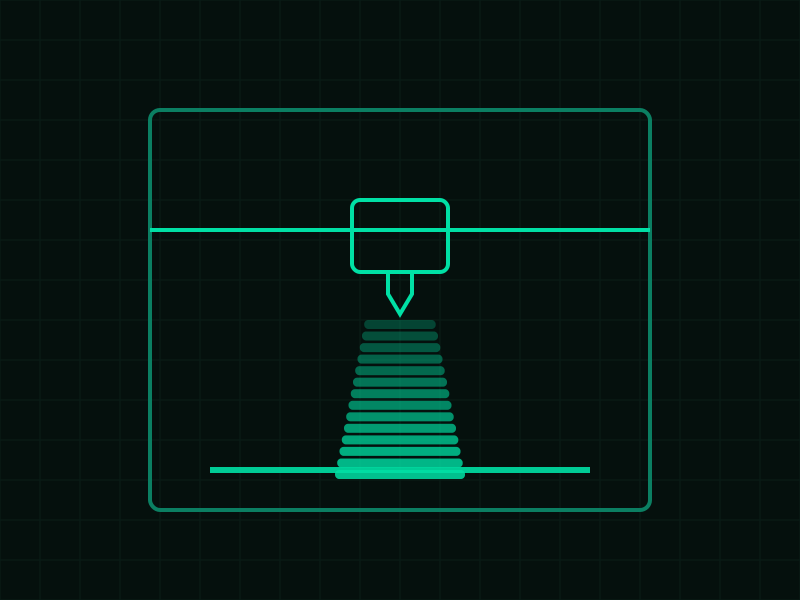
A part printing on a gantry-style 3D printer

01 · You already have the model

Custom 3D printing

Send an STL, STEP, 3MF or OBJ and we'll print it. Before anything runs we check the file properly — wall thickness, overhangs, whether the orientation puts a layer line straight through the part of it that carries load — and tell you what we'd change and why.

  • One-off prototypes through to short runs of fifty or so
  • Material advice for the actual job, not just what's loaded
  • Post-processing: support removal, sanding, heat-set inserts, threaded fasteners
  • Printability report on the file before you commit
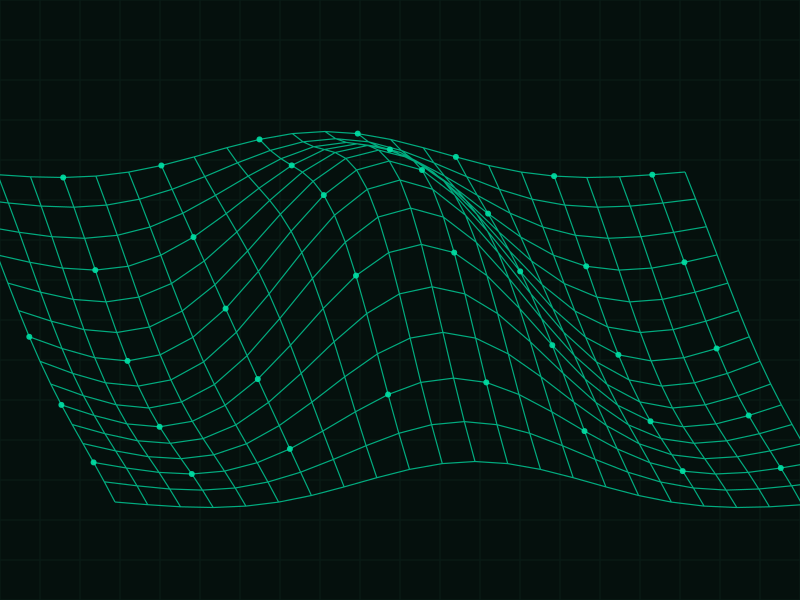
A curved surface shown as a CAD wireframe mesh

02 · You have an idea

3D modelling & CAD

Describe the part, sketch it on paper, or just show us the gap it has to fill. We model it in parametric CAD so the dimensions stay editable — when version two needs a hole moved 4 mm, that's a parameter change rather than a redraw.

  • Parametric solid modelling with a clean, editable feature tree
  • Assemblies and fit checks against existing hardware
  • Dimensioned drawings to ISO 2768-m if you need them for manufacture
  • You receive the native file and a STEP — the model is yours to take elsewhere
A physical part captured as a dense 3D point cloud

03 · You have the broken original

Reverse engineering

Obsolete, discontinued, or snapped in half. Send us the part — or the pieces — and we measure it up and rebuild it as a proper model. Where the original failed because of how it was made, we'll usually redesign that section rather than faithfully reproduce the weakness.

  • Digital calipers and thread gauges for hard dimensions; scanning for organic shapes
  • Failure review — we'll say what broke and why before reprinting it
  • Reinforcement where the original was under-designed
  • Fit confirmed against your hardware before the final print
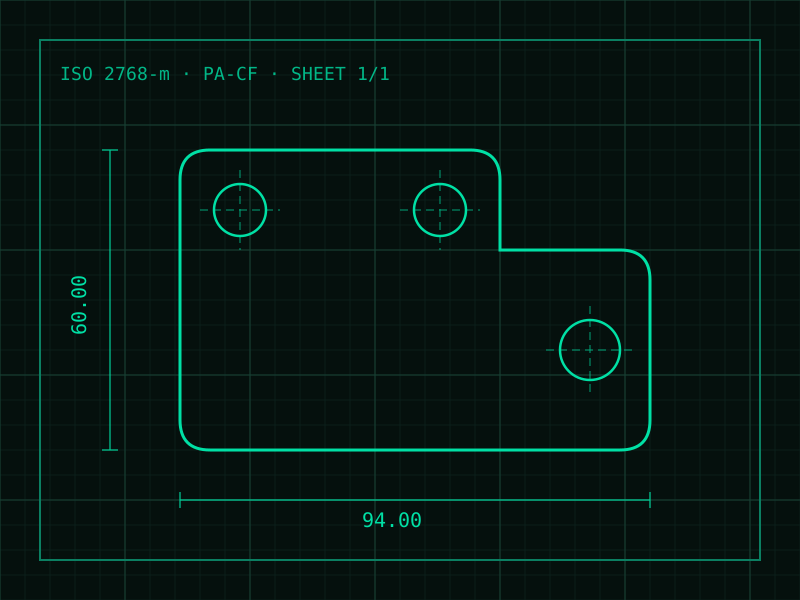
A dimensioned engineering drawing of a bracket

04 · Your file won't print properly

Design for additive manufacture

A model that's correct in CAD isn't automatically a model that prints well. We take files that are failing, warping, or coming out weak in the wrong axis and fix the geometry — then tell you what to do differently next time.

  • Mesh repair: non-manifold edges, flipped normals, self-intersections
  • Reorientation and part splitting to get strength in the right direction
  • Fillets, chamfers and draft added where the print needs them
  • Tolerance and clearance sizing for parts that have to fit together

Process

How a job runs

Same five steps whether it's one bracket or a batch. You approve before we print, and nothing is invoiced until you've seen it.

01

Enquiry

You send what you have — file, sketch, photo, or a description with the critical dimensions.

02

Quote

Fixed price and lead time back, usually within 1 business day. Material and finish confirmed here.

03

Model

Design or file prep, then a render or a cross-section for you to sign off. Two revisions are included.

04

Print

Printed, supports removed, finished by hand and dimensionally checked against the model.

05

Ship

Photos before it's packed, then posted Australia-wide or picked up in Perth. Files sent on delivery.

Capability

What the machine will do

Everything is printed in-house on a dual-nozzle machine with a heated chamber. If your part is bigger than the build volume it can usually be split and bonded — ask.

Printer capability
ProcessFused filament fabrication · dual nozzle · heated chamber
Build volume330 × 320 × 320 mm
Max temperatures350 °C max hotend · 120 °C bed · 65 °C chamber
Layer height0.08 – 0.28 mm
Dimensional tolerance±0.2 mm or ±0.2%
Accepted file typesSTL, STEP, 3MF, OBJ, F3D, IPT
Materials
MaterialBest forMax service tempUV / outdoor
PLADisplay pieces, fine detail, prototypes~55 °CPoor
PETGGeneral-purpose parts, brackets, enclosures~75 °CFair
ABS / ASAHousings and trim; ASA for anything in full sun~95 °CVery good (ASA)
TPUGaskets, bump stops, flexible mounts~70 °CFair
PCImpact resistance and structural clarity~115 °CFair
PA-CFStiff load-bearing parts and wear surfaces~120 °CGood
PPA-CFHigh-temperature structural parts, under-bonnet~150 °CGood
PPS-CFChemical resistance and continuous heat~200 °CVery good

Service temperatures are indicative for printed parts under light load — tell us the real duty and we'll pick the material. Glass-filled (GF) grades of most of the above are available too. PPA and PPS are quoted per job; they run hot, slow and expensive, so we'll only recommend them where the part genuinely needs them.

Enquiry

Tell us about the part

The more you can say about what it has to do, the tighter the quote. No detail is too obvious.

What do you need? *

Have a file? Send the enquiry first — we'll reply with somewhere you can send STL, STEP or 3MF files. Nothing you send is shared or reused.